Every year, Salt Awareness Week shines a light on a health issue that often goes unnoticed – the excessive amount of sodium hidden in everyday foods. It’s a growing concern for public health, and a timely prompt for both consumers and the food industry to rethink how we approach sodium, especially in the foods we eat most frequently.
Burgers are a prime example – a global staple found in restaurants, home kitchens, and on supermarket shelves. As BBQ season approaches, it’s worth taking a closer look at one of the most popular food items on the menu.
The breakdown: Where’s all the salt coming from?
When we think about the health profile of a burger, we often talk about calories and fat, but sodium is a major contributor which is often overlooked.
Here’s a typical breakdown:
- Burger bun: 328mg
- Pre-seasoned beef patty: 404mg
- Cheese slice: 180mg
- Ketchup: 120mg
Total: 1,032mg of sodium*
That’s over 50% of the World Health Organisation‘s daily recommended maximum of 2,000mg of sodium (which is about 5 grams of salt) in just one burger, and that’s before adding fries, sauces, or extra toppings.
For consumers, that means a single meal could push them beyond their sodium limit without even realising it. This unintentional overconsumption raises significant health concerns, particularly around blood pressure and heart disease. For manufacturers, it’s a clear indication that sodium reduction must be part of the discussion, not just as a regulatory or marketing consideration, but as a vital step in promoting public health and meeting evolving consumer expectations for healthier food options.
Why Sodium Reduction Matters Now
With new HFSS regulations taking effect from October 2025, pressure is mounting on manufacturers to reduce salt across product lines. But this isn’t just about compliance. At the same time, consumers are more aware than ever of the health risks linked to high sodium intake, and many are actively seeking lower-salt products as part of a broader shift toward “better-for-you” indulgence**.
In fact, the World Health Organization estimates that excessive sodium consumption contributes to 1.89 million deaths globally each year. According to the British Heart Foundation, adults in the UK consume an average of 8.4 grams of salt daily, which is 40% above the recommended maximum of 5 grams. This excess is closely linked to high blood pressure, a major risk factor for heart disease and stroke, which remain the leading causes of death worldwide. Action on Salt reports that reducing average salt intake by just 1 gram per day could prevent over 4,000 premature deaths annually.
Saltwell: A Smarter Sodium Solution
That’s where Saltwell comes in. Extracted from a natural hypersaline body of water under the Atacama salt flats, Saltwell is a clean-label, naturally low-sodium sea salt that performs like conventional salt but with 35% less sodium.
Why manufacturers choose Saltwell:
✅ Naturally 35% less sodium than standard salt.
✅ Easy adoption into food manufacturing processes, reducing development time and costs.
✅ Suitable in a range of applications including meat, bakery, dairy, sauces, snacks, and more.
Because it behaves just like regular salt, Saltwell can be used across every burger component – from bun to patty to cheese – without impacting flavour, processing, or shelf stability.
Reformulating with Saltwell
Let’s revisit our earlier burger example and reformulate with Saltwell across the components:
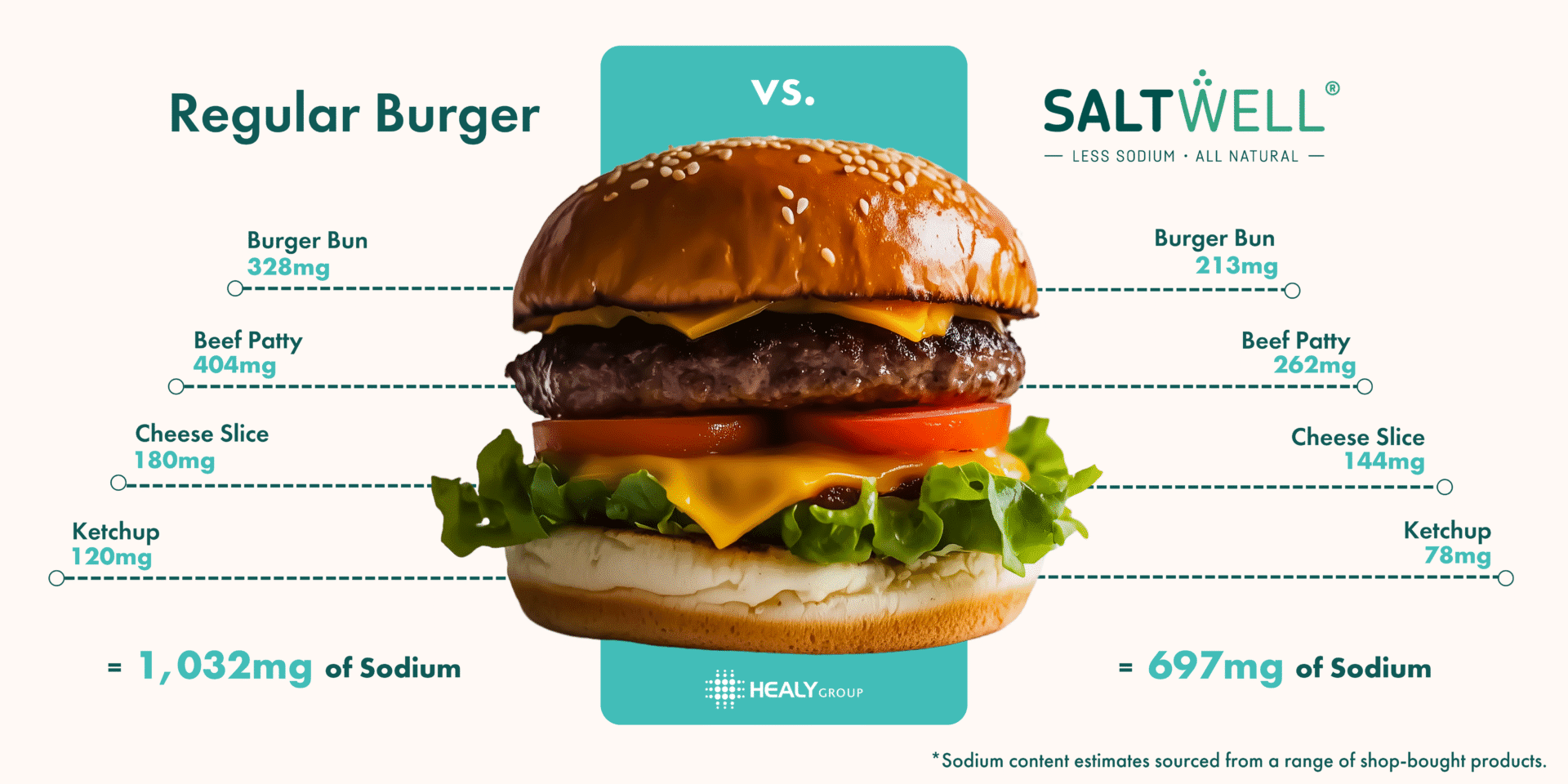
That’s a reduction of 335mg of sodium per burger, a significant reduction that aligns with both regulatory goals and consumer expectations. Why not offer consumers a burger they can enjoy fully – sides and all – without the worry of too much sodium?
Let’s Talk!
If you’re ready to tackle sodium reduction in your products, we’re here to help. From flavour-forward solutions to full reformulation support, our team can guide you in creating burgers that are both better-for-you and big on taste.
Contact us today to request a sample and explore how we can help you meet the demand for lower-sodium solutions without compromising on flavour, texture, or customer satisfaction.
*Sodium content estimate sourced from a range of shop-bought products.
**FMCG Gurus, Savory food & snacks report, 2023